Cycling has boomed in recent years and thousands of shiny new bikes are being pedalled. That leaves motorhomers with a few questions. Chiefly, how on earth do you get your bike to the campsite? While some super-fit cyclists might think nothing of riding to a campsite, for most mortals, you’re going to need a campervan or motorhome bike rack. So what are your options?
Here, I’m talking you through everything you need to know about these motorhome upgrades.
If you prefer a different way to get around when you’re on tour, you can always consider taking a motorbike on a motorhome tour, too.
It all starts with payload
As with so many things, it begins with motorhome weights. Before you start comparing motorhome bike racks, you will need to check your payload.
It’s best to have your ’van weighed on a weighbridge, with all of your usual touring kit on board, as a first step (search online for ‘public weighbridge’ or ‘scrap metal merchant’ to find your nearest one). Brochure weights do not take into account accessories you might add or the weight of your own equipment. If you find you need to lighten your ‘van, my tips on how to reduce the weight of your motorhome can help here.
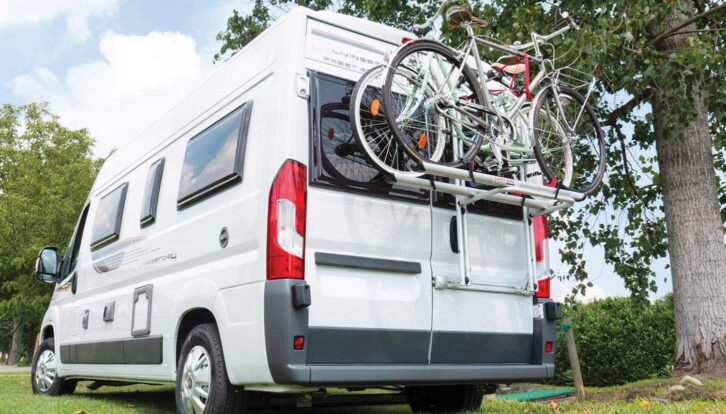
As well as overall payload, you need to consider the maximum weight your rear axle can carry (weigh each axle separately on the weighbridge). Vehicles running close to their maximum axle limit with a long rear overhang will place extra load on the rear axle, because of the cantilever effect – in this case, seek advice from your motorhome manufacturer.
In addition to the vehicle payload, all carriers have a maximum weight limit and you also need to factor in the weight of the rack itself. Cheaper ones tend to be made of steel, while the better quality versions use extruded aluminium parts to maximise their payload.

Ebikes are increasingly popular, with options such as the Ribble CGR E AL Sportfit Apex XPLR and the Tenways CGO600 Plus.

If you have ebikes – which can weigh twice as much as a regular bike – you need to look closely at the rack payloads, because not all are suitable. Various brands offer ebike-specific racks.
Legal stuff
Whichever type of cycle carrier you go for, the bikes must not obscure your rear numberplate or tail-lights. If they do, you must fit a trailer board with built-in lights (but no reflective triangles, which are only for trailers and caravans) and plug it into your vehicle electrics.

Most towbar-mounted motorhome bike racks have lights and a numberplate holder built in, which plugs into your vehicle electrics.
Rear-panel carriers
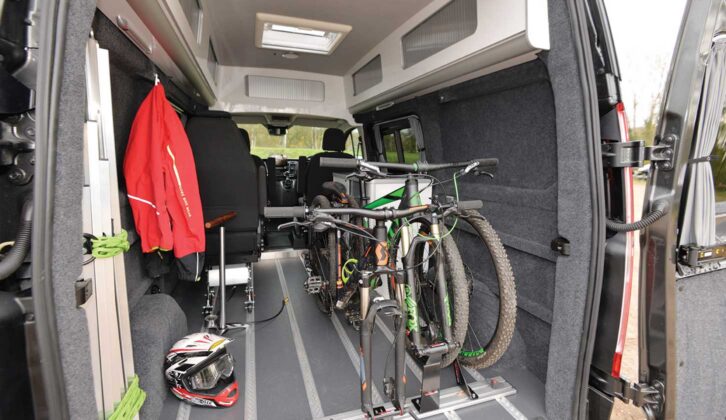
Keen cyclists tend to opt for motorhomes with a built-in garage or campervans that feature sliding rear seats. Many even specify bespoke motorhome layouts and these are the most secure way to carry expensive bikes. But if you can’t stash your bike inside your ’van, what are your options?
Many coachbuilts and A-class motorhomes come with mounting brackets in their rear panel, and these are the easiest way to fit a rack. Fiamma offers a huge range of them.
If you’re adding one to a motorhome without brackets, you can fit these first, with suitable spreader plates on the inside of the rear panel, before installing your chosen rack. Not all rear walls are suitable for this, so seek manufacturer advice first, especially for any models where the washroom is sited along the rear wall or there is a rear-facing hatch.
Rear-wall mounted motorhome bike racks tend to be fitted above the rear-light panel, which is often moulded to cover the rearmost chassis section and not structural, and this can put them quite high up on the wall, making loading your motorhome trickier. Lifting a bike above your head is never fun and ebikes will test your back. Take care not to exceed their maximum weight capacity, too – easily done with steel-framed bikes and ebikes.

For panel van conversions, there are a couple of other options. Large ’vans, such as the Ducato, can be fitted with barn-door mounted racks, but these need to be used with care. Typically, they’re designed to hold a couple of lighter bikes and are not best suited to heavier ebikes because the weight is limited by the hinge strength and the rear-door panel strength. You also need to load them carefully and take care when opening the door – they can’t be swung past 90 degrees (or you risk damaging the side panel).
Medium-size vehicles, such as the VW Transporter (one of the best vans for converting to a camper), can be specified with tailgate bike racks, with Volkswagen offering a dedicated model that holds up to four bikes. It folds vertically when not in use and can be specified in versions to suit the T5 and T6. The downside is that it’s quite high up for loading. Again, follow the advised weight limit for these to avoid damaging the tailgate panel. Generally, if the manufacturer offers a dedicated bike rack, then that’s the best option.
Universal tailgate racks are also available for medium ’vans, but these can vary in how securely they fit. Things to watch out for are overtightening clamps and damaging paintwork.
Towbar-mounted bike racks
If you have heavier bikes that you want to load without having to lift them up high, the best option is a towbar-mounted rack. The bonus is that they’re a one-time buy, which
can easily be transferred to any vehicle. Rear-panel racks tend to be sold on with the ’van when you trade it in.
Not all coachbuilts can have a motorhome towbar fitted, so you’ll need to check with your manufacturer or a specialist towbar fitter, and vehicles made after April 2012 are best fitted with a type-approved towbar (strictly speaking, not needed for just a bike rack as the legislation is aimed at towing, but it’s still advisable to fit an approved model).

Again, if you have a limited payload, make sure you allow for the weight of the towbar framework – this can be more substantial on older vehicles that lack substantial rear bracing.
Most campervans, whether based on a large or a medium-size vehicle, tend to be able to have a towbar easily fitted for a modest cost – think of it as a universal fixing point for all manner of kit, rather than just a device to lug trailers. You can even get detachable models for many medium-size ’vans, if you want an unobtrusive look when you’re not carrying bikes. Whichever type and brand of towbar you opt for, the good news is, there are lots of motorhome bike rack options for them.
The budget models tend to be steel-framed and more awkward to load, with tools needed to fit them. While this can be fine for occasional use, they will drive regular cyclists mad, so it’s worth paying a little extra for an aluminium model with a quick-release clamp.

The posher ones also have fixed arms with individual locks to secure your bikes and can be specified to suit two, three or four cycles. Check these are suitable for your particular bike, though, because there are a multitude of different frame designs these days.
Some motorhome bike racks fold down flat, which makes them easier to store at home when they’re not in use. It’s also worth looking out for ones with a tilting or sliding mechanism – this allows you to open the tailgate or barn doors without having to unload the bikes.
Check the tension
No matter which type of campervan or motorhome bike rack you have, it’s good practice to load the bikes with plenty of padding between them (foam rubber pipe lagging is ideal) and invest in some good quality, load-rated luggage straps. If anything is loose when you’ve strapped it down, adjust it. If it’s loose on your driveway, at motorway speeds you’re risking it becoming detached from the bike rack – and make sure you know your motorhome speed limits in the UK too.

When you set off, after 10 minutes of driving, stop and check the bikes are still secure. Get into the habit of doing this every time you stop for a break – straps love to work loose with vibration.
Buy a marker board
If you plan on travelling to the EU, it’s best to add a marker board to your bike rack. The regulations vary from country to country, with many insisting on a 50cm by 50cm red-and-white reflective diagonal-striped board. Aluminium versions are accepted in most countries, so we’d advise using these, rather than plastic ones.
Apparently, the stripes should point up to the offside of the country in which you’re driving (who knew?). It’s wise to check the specific rules for the countries you’re visiting.
Keeping your bike safe
If you are lucky enough to have an expensive ebike or carbon-framed bike, keeping it safe in transit and when you’re pitched up at one of the best campervan sites for cyclists requires extra consideration. Choose bike locks and chains that are Sold Secure approved to Gold or Diamond standard, and try not to leave the bikes unattended when you take a break. Park in well-lit areas, next to CCTV if possible. Many campsites offer secure bike storage, so it’s always worth asking about this.
Bear in mind that any lock or chain is only as strong as the thing you attach it to – thieves will often cut through wheel rims or flimsy rack parts to remove bikes. So if you can, chain your bikes through the frame to the towbar structure, or to something substantial, such as a steel fence or a lamp-post. That said, little will stop a professional thief, so make sure your bikes are insured in transit, as well as being named items on your household insurance.
Don’t miss our tips on towing a car with a motorhome either, as it can provide an attractive way of getting around when you’re on tour.
Some suppliers
- Approved locks
- Rear and towbar cycle carriers
- Budget rear racks
- Motorhome bike racks
- Rear and towbar racks
- All types of cycle carrier
- Bike Lift
Future Publishing Limited, the publisher of Practical Motorhome, provides the information in this article in good faith and makes no representation as to its completeness or accuracy. Individuals carrying out the instructions do so at their own risk and must exercise their independent judgement in determining the appropriateness of the advice to their circumstances. Individuals should take appropriate safety precautions and be aware of the risk of electrocution when dealing with electrical products. To the fullest extent permitted by law, neither Future nor its employees or agents shall have any liability in connection with the use of this information. Double check any warranty is not affected before proceeding.
If you’ve enjoyed reading this article, why not get the latest news, reviews and features delivered direct to your door or inbox every month. Take advantage of our brilliant Practical Motorhome magazine SUBSCRIBERS’ OFFER and SIGN UP TO OUR NEWSLETTER for regular weekly updates on all things motorhome related.
Leave a Reply